Zijie (Noah) Qu
I’m a mixed-methods UX researcher with a PhD in cognitive human factors engineering and a background in design. I study how people understand and use communication technologies, with a focus on conversational systems and digital health.
My postdoctoral project uses competitive analysis and mixed-method observational study to evaluate AI-enabled clinical decision support tools for primary care physicians in Ontario.
My doctoral research combined mixed-method experiments and usability studies to investigate voice assistants for older adults. I designed and evaluated prototypes for tasks including product assembly, reminiscence, and accessing health information, translating findings into design guidance.
My design practice includes interactive installations, mixed-reality experiences, and user interface design.

UX/Human Factors Research
Please see my latest human factors/UX research projects on Google Scholar.
Two Examples
These two projects explored how voice assistants can be designed to support older adults’ confidence and independence.
In the first study, older adults completed a product assembly task with either a voice assistant or human voice support. I used repeated-measures ANOVA to test changes in task-specific and general self-efficacy over time and to compare the two experimental conditions. I also examined post-study and one-month follow-up differences using effect sizes and confidence intervals to assess whether changes were sustained. The results showed that both groups improved after the task, while the voice assistant group showed a more sustained increase in task-specific self-efficacy at the one-month follow-up.
In the second study, I used a 2 × 2 mixed-method experiment and Wizard-of-Oz prototyping to compare mastery-based and observational instruction for online health information seeking. I used a non-parametric ANOVA approach (ARK) to test the interaction between assistant type and instruction type. I then used Mann-Whitney U tests as follow-up analyses to compare mastery and vicarious instruction within the voice assistant condition. The results suggested that observational instruction led to higher perceived system usability and greater self-efficacy in using the voice assistant.

Presentation of my doctoral research at TorCHI Meetup.


Presentation of my doctoral research at TorCHI Meetup.
New Media Art/Interaction Design
‘CARE, ROBOT’ is an interactive story game that encourages a thinking about socially assistive robots in elderly care. By inviting the audience to investigate a fictional robot company’s virtual archive, the work shows four fictional stories reflecting four ethical concerns of the use of robots respectively. The work asks the audience to speculate on ways in which the ‘right’ standards of the limited support provided by robots might improve elderly care.
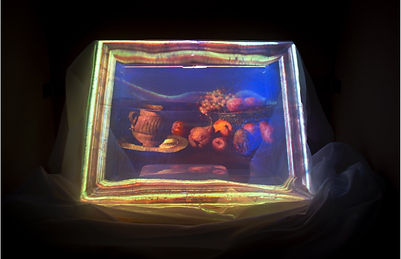
‘You’re in the Way’ addresses the different levels of ‘noise’ (social, visual, audible) that appear as a result of the expansion of mass-tourism. This project features a 3D-printed model taking the form of a specific cultural artifact, in this case a painting. Projected on the model are the visual details of the artifact providing an extra dimension of color and texture which draws viewers closer to the illuminated model. The audio that is emitted from the piece is a verbal narration, from an individual closely connected to the artifact, describing the actual location where the artifact is found and the intimate connection made with said object. As viewers are drawn in by the narration and come closer to inspect the models a new layer of audio begins to overlap and the detailed projection begins to blur. The ‘noise’ layer gradually obstructs the narrative with the ‘sounds of overtourism.’ As viewers become overwhelmed by this noise and leave; the noise falls away revealing the verbal narrative underneath. This project is an interactive piece that utilizes public spaces to illustrate the degradation of cultural centers around the world due to overtourism. As the world halts due to the Covid-19 pandemic and the practice of social distancing becomes the new norm, ‘You’re in the Way’ proposes an opportunity to envision an alternative to the detrimental effects of overtourism. The future of this project would see additional models, specific to locations which they would be situated, for example the Corinthian capital and Japanese Torii.


‘the hourglass’ is a participatory design project that highlights the systemic marginalisation of ex-offenders through exploring how time as a phenomenon is experienced in isolated environments. By looking into the personhood of prisoners and its destruction during incarceration, we question the current value of the prison system and try to critically analyze its impact on the daily life of ex-offenders. As the final outcome, we conducted online workshops and designed a web-based storytelling to mediate the stories.
'One Side' is a transmedia storytelling project that shows how digital mediation shapes the political election in the 21st century. The work reveals how political organizations use digital media to manipulate the public voice by selecting three examples of manipulation— fake photos in propaganda, fake news, and political shows as materials.

‘Infinity VS The Company’ is a transmedia puzzle adventure that takes place in a dystopian future where digital time is the new currency. Participants are asked to investigate a hack against global corporation Bancroft Industries. The work uses a speculative narrative to criticize digital exclusion and reflect the privilege of digital life in an alternative reality game.


Projection Mapping
Drawing


